 Français
 Español
 English
 Portuguese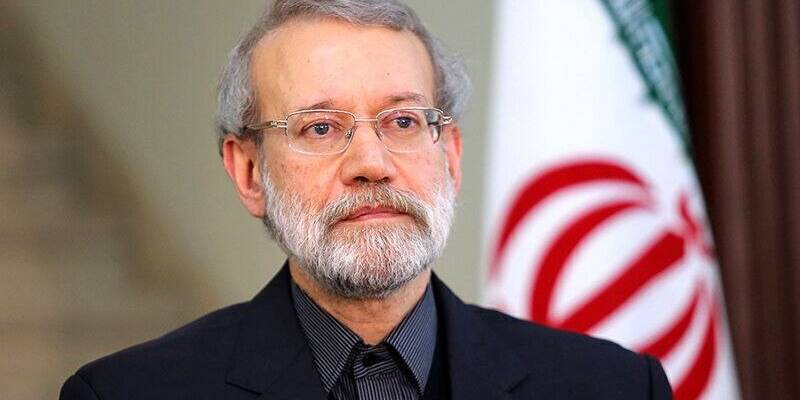
Instead of foregrounding Larijani’s role within a regime accused of violently suppressing protests, coverage leaned into biography. Scholar. Pragmatist. A man of ideas.
By Dr. Rinat Harash, HonestReporting
Western media went out of their way this week to portray Iran’s regime de facto boss, Ali Larijani, who was killed in an Israeli air strike, as a pragmatic philosophy scholar rather than a man responsible for the violent machinery of the regime.
The pattern in coverage was consistent and revealing. NBC News called him a “bookish front man for the regime.”
The Guardian chose to highlight his demeanor, noting his “warm smile.” The New York Times referred to him as a “Top Iranian Politician and Emissary.”
The BBC said he was “one of the Islamic Republic’s most experienced and influential policymakers,” while The Washington Post described him as a mere “security official.”
"Security official."
That's @washingtonpost's descriptor for Ali Larijani, who has been described as the de facto leader of the Islamic Republic in recent weeks.
He's no civil servant. He's responsible for the deadly protest crackdowns and the deaths of thousands of Iranians. pic.twitter.com/ln0PDwt6E9
— HonestReporting (@HonestReporting) March 18, 2026
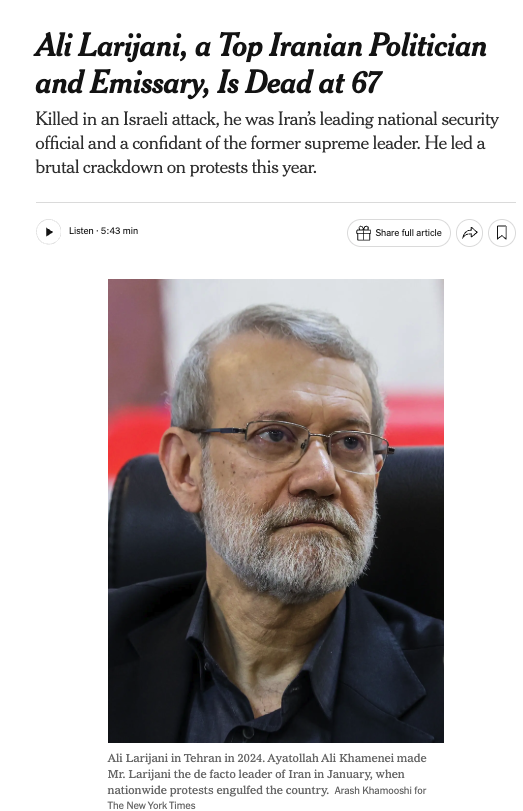
And across outlets, there was repeated emphasis on his academic credentials. A Ph.D. in philosophy. An expert on the philosopher Immanuel Kant. As if intellectual biography could stand in for moral accountability.
In reality, Larijani, as head of Iran’s National Security Council, was not a detached intellectual. He was a central figure in a system of repression. A system that has cracked down on dissent with brutal force. A system that spread terror and death worldwide.
Larijani was a ruthless actor who did not seem to internalize Kant’s moral maxim: “Act as to treat humanity, whether in your own person or in another, always as an end and never as only a means.”
So what the media did was not incidental. It was framing.
Instead of foregrounding Larijani’s role within a regime accused of violently suppressing protests, coverage leaned into biography. Scholar. Pragmatist. A man of ideas.
The implication was clear. This was someone who might have mattered for diplomacy.
On social media, that framing went even further. New York Times columnist Nicholas Kristof and BBC presenter John Simpson effectively lamented Larijani’s death, suggesting he might have been able to “hammer out a peace deal.”
They ignored the more immediate reality. He hammered protesters instead.
I fear @vali_nasr is right. When I met Ali Larijani I found him an absolute insider kingpin of the Iranian regime — but also the kind of strong and pragmatic leader who just might be able to hammer out a peace deal. Not sure, but I wonder if the war will now be harder to end. https://t.co/qSC2QSqoBy
— Nicholas Kristof (@NickKristof) March 17, 2026
this is what he deleted btw https://t.co/gCsep5W0Pm pic.twitter.com/R6F27inPBj
— Jerry Dunleavy IV 🇺🇸 (@JerryDunleavy) March 17, 2026
And the emphasis on Larijani’s intellectual profile created a distortion. It suggested that studying Kant somehow mitigates responsibility for actions taken in power. That philosophical sophistication signals moral restraint.
But Kant’s philosophy is not a decorative detail. It is a moral standard. And by that standard, Larijani’s record stands in direct contradiction.
Ignorant writers see brilliant rationality as a mark of virtue. They don’t know it has been historically portrayed as the mark of the devil. And in general, they mix up ethics with academic achievements.
The result was a portrait that elevated intellect while muting accountability. A man responsible for deadly decisions within a violent regime was presented, above all, as a clever, rational scholar.
Larijani eventually received what Kant really meant by the second formulation of his moral maxim: “Act only according to that maxim by which you can at the same time will that it should become a universal law.” He wanted universal death for anyone who defied him, and he got it.
Do You Love Israel? Make a Donation - Show Your Support!

Donate to vital charities that help protect Israeli citizens and inspire millions around the world to support Israel too!
Now more than ever, Israel needs your help to fight and win the war -- including on the battlefield of public opinion.
Antisemitism, anti-Israel bias and boycotts are out of control. Israel's enemies are inciting terror and violence against innocent Israelis and Jews around the world. Help us fight back!

