 Français
 Español
 English
 Portuguese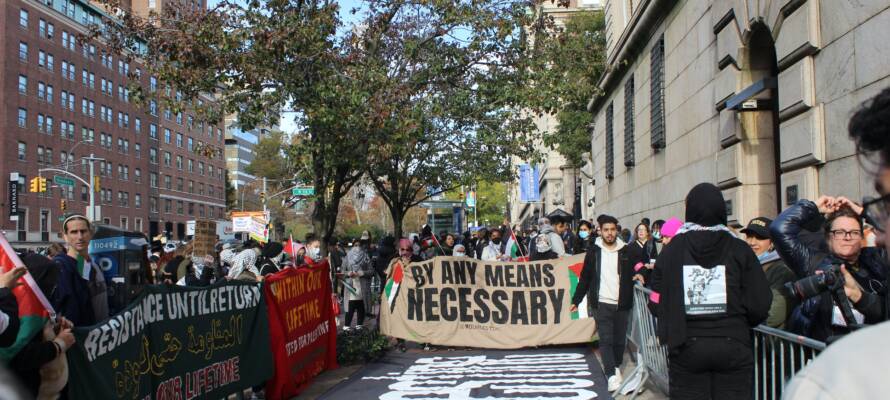
Columbia said that the group behind the boycott proposals lacks consensus support on campus.
By Dion J. Pierre, The Algemeiner
Columbia University said on Friday that it will not divest from Israel and other corporations which anti-Zionist activists denounced for selling materials to the Israeli military.
The university’s Advisory Committee on Socially Responsible Investing (ACSRI) stated its position on the matter as a response to a group which submitted three proposals calling for the policy in December 2024, when the institution’s campus was being roiled by anti-Israel protests and a deluge of antisemitic incidents.
The group had charged that Israel is guilty of “human rights violations” and “war crimes.”
Israel argued it went to unprecedented lengths to try and avoid civilian casualties during the latest war in Gaza, noting its efforts to evacuate areas before it targeted them and to warn residents of impending military operations with leaflets, text messages, and other forms of communication.
It noted that Hamas, the Palestinian terrorist group it was targeting, embedded its fighters within Gaza’s civilian population and commandeered civilian facilities like hospitals, schools, and mosques to run operations and direct attacks.
In three separate statements, Columbia said that the group behind the boycott proposals lacks consensus support on campus and has reduced one of the most complex geopolitical conflicts in the world history to “vague and excessively broad” categories, sowing partisan division and confusion where a university would, ideally, aim to promote clarity and sober analysis of fact.
Additionally, ASCRI said that the group’s proposals are of “similar … substance” to other ideas put forth by the notorious Columbia University Apartheid Divest (CUAD) group, a spinoff of Students for Justice in Palestine (SJP) that Columbia resolved neither to recognize nor correspond with due to its culpability in antisemitic assaults, hate speech, and a slew of illegal occupations of campus property.
“As noted in the ASCRI’s decision on the CUAD proposal last year, members of the university have a wide range of views on contentious issues,” ASCRI wrote.
“Hence, it will be difficult or unprecedented for the university, with such diverse views, to sponsor shareholder proposals of the kind this proposal envisages.”
It added, “There is significant opposition in the Columbia University community to divesting from companies that are involved in Israel, as evidenced by the actions of many students, faculty, and alumni.”
Columbia University has begun implementing a series of reforms it says will address campus antisemitism.
In a statement issued in July, university president Claire Shipman said the institution will hire new coordinators to oversee complaints alleging civil rights violations; facilitate “deeper education on antisemitism” by creating new training programs for students, faculty, and staff, and adopt the International Holocaust Remembrance Alliance (IHRA) definition of antisemitism—a tool that advocates say is necessary for identifying what constitutes antisemitic conduct and speech.
Shipman also announced new partnerships with the Anti-Defamation League (ADL) and other Jewish groups while delivering a major blow to the anti-Zionist movement on campus by vowing never to “recognize or meet with” CUAD, a pro-Hamas campus group that has serially disrupted academic life with unauthorized, surprise demonstrations attended by non-students.
“I would also add that making these announcements in no way suggests we are finished with the work,” Shipman continued.
“In a recent discussion, a faculty member and I agreed that antisemitism at this institution has existed, perhaps less overtly, for a long while, and the work of dismantling it, especially through education and understanding will take time. It will likely require more reform. But I’m hopeful that in doing this work, as we consider and even debate it, we will start to promote healing and to chart our path forward.”
Columbia University had, until that point, yielded some of the most indelible examples of anti-Jewish hatred in higher education since Hamas’s Oct. 7, 2023, massacre in southern Israel set off explosions of anti-Zionist activity at colleges and universities across the US.
Such incidents included a student who proclaimed that Zionist Jews deserve to be murdered and are lucky he is not doing so himself and administrative officials who, outraged at the notion that Jews organized to resist anti-Zionism, participated in a group chat in which each member took turns sharing antisemitic tropes that described Jews as privileged and grafting.
Amid these incidents, the university struggled to contain CUAD, which in late January committed infrastructural sabotage by flooding the toilets of the Columbia School of International and Public Affairs (SIPA) with concrete.
Numerous reports indicate the attack may have been the premeditated result of planning sessions which took place many months ago at an event held by Alpha Delta Phi (ADP) — a literary society, according to the Washington Free Beacon.
During the event, ADP reportedly distributed literature dedicated to “aspiring revolutionaries” who wish to commit seditious acts. Additionally, a presentation was given in which complete instructions for the exact kind of attack which struck Columbia were shared with students.
Columbia has since paid over $200 million to settle claims that it exposed Jewish students, faculty, and staff to antisemitic discrimination and harassment — a deal which secures the release of over $1 billion dollars the Trump administration impounded to pressure the institution to address the issue.
“Columbia’s reforms are a roadmap for elite universities that wish to retain the confidence of the American public by renting their commitment to truth-seeking, merit, and civil debate,” US Education Secretary Linda McMahon McMahon said at the time.
“I believe they will ripple across the higher education sector and change the course of campus culture for years to come.”
Do You Love Israel? Make a Donation - Show Your Support!

Donate to vital charities that help protect Israeli citizens and inspire millions around the world to support Israel too!
Now more than ever, Israel needs your help to fight and win the war -- including on the battlefield of public opinion.
Antisemitism, anti-Israel bias and boycotts are out of control. Israel's enemies are inciting terror and violence against innocent Israelis and Jews around the world. Help us fight back!

