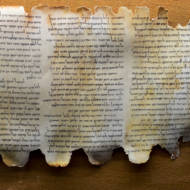
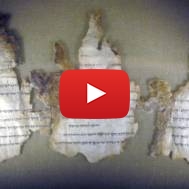
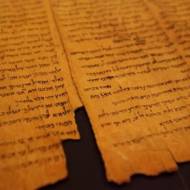
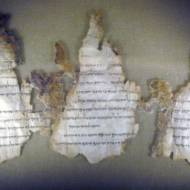
The Great Isaiah Scroll, one of the seven Dead Sea Scrolls and the oldest complete copy of the Book of Isaiah, is going on public display in full for the first time since 1968.
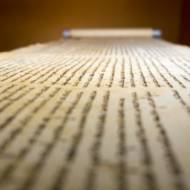
The 7.34-meter-long manuscript, discovered in 1947 at Qumran, dates to the second century BCE and is the oldest nearly complete copy of a book from the Hebrew Bible.
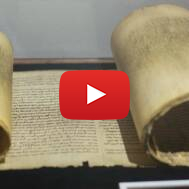
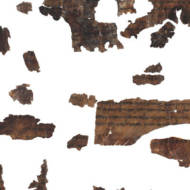
The Dead Sea Scrolls—2,000-year-old manuscripts containing some of the earliest known biblical texts, discovered near the Dead Sea in Israel—are now on display at the Museum of the Bible in Washington, D.C.
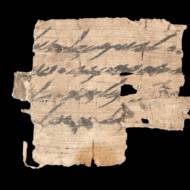
The document, dated to the late seventh or early sixth century BCE, is written in ancient Hebrew script on papyrus, and probably originated in the Judean Desert caves.
A scientific investigation funded by the Museum of the Bible confirmed that all 16 fragments of the Dead Sea Scrolls on display at a Washington, D.C. museum are forgeries.
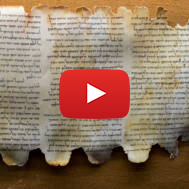
The Dead Sea Scrolls remain the holy grail of Israeli antiquities and archaeological teams near the famous caves where the scrolls were found are on the hunt for additional scrolls.
People in Denver are very excited about an exhibit of ancient artifacts from Israel, including two Dead Sea Scrolls shown to the public for the first time.
In one of the most exciting archaeological discoveries in the last 60 years, archeologists have found more evidence surrounding the famous Dead Sea Scrolls.
As part of their continued effort to rewrite history and deny the Jewish people's undeniable connection to the land of Israel, the Palestinians are now aiming to claim the Dead Sea Scrolls as their own.
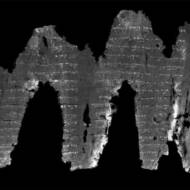
This is the first time researchers have been able to read the text of an ancient scroll without having to physically open it and this scroll proves the version of the Hebrew Bible used today is identical to the one from 2,000 years ago.
Scientists used advanced technology to unravel a decades-old mystery, managing to unlock an amazing archaeological treasure discovered in the ancient synagogue of Ein Gedi.
 Français
 Español
 English
 Portuguese