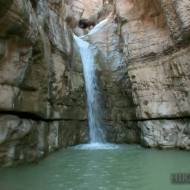
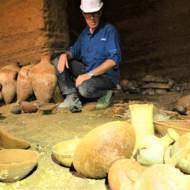
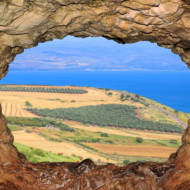
While carving a new road through Samaria, builders unexpectedly broke into a hidden, million-year-old underground world of breathtaking caves, rare formations, and unique life.
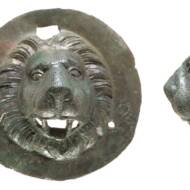
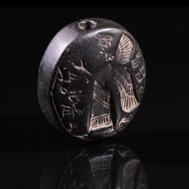
Each of the four discs features a different facial expression and distinctive details in the mane, eyes, and nose, underscoring the craftsmanship and individualized nature of the ornaments.
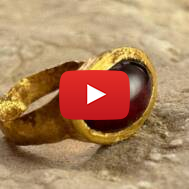
A 2,300-year-old gold ring with a red gemstone—nearly identical to one found just months ago—was unearthed in Jerusalem’s ancient City of David, stunning Israeli archaeologists.
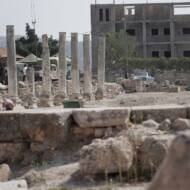
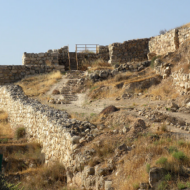
Israel is investing millions in an excavation project at Sebastia, capital of the Israelite Kingdom during the reigns of Omri and Ahab, aiming to preserve the site and make it accessible to the public.
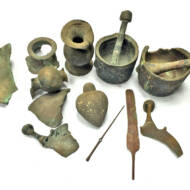
Evidence of tools used to produce scarlet dye at coastal site of Tel Shikmona point to a production hub sophisticated enough to support regional trade, royal patronage, and even the First Temple in Jerusalem.
'And Joshua passed on from Libnah, and all Israel with him, to Lachish, and encamped against it, and fought against it. And G-d delivered Lachish into the hand of Israel...
The cache of four swords and a shafted javelin-like weapon called a pilum was found in a crevice in a cave in the Ein Gedi Nature Reserve near the Dead Sea.
The Institute for Archaeological Seminars at Beit Guvrin invited families and children to visit Tel Maresha in Beit Guvrin, a UNESCO World Heritage Site in Israel’s Lachish region.
Up until recently, Israel has refrained from enforcement against violations of archeological sites not in Judea and Samaria's 'Area C,' which is under full Israeli control.
Hebrew University study shows that the kingdom began expanding south of Jerusalem as early as the 10th century BCE, in accordance with biblical accounts.
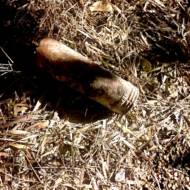
'We washed it. We were trying to understand what it was. ... We thought we found treasure, but we found a bomb,' said the young Israeli who made the find.
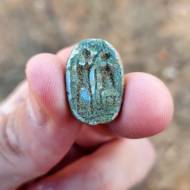
'At first, I thought it was a toy lying in the dirt, but an inner voice said to me: ‘Pick it up and turn it over!’ explained Gilad Stern of the Israel Antiquities Authority Educational Center.
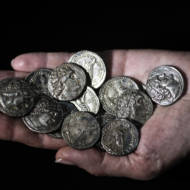
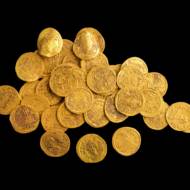
'The discovery of the coin hoard may also shed light on the economy of the city of Banias during the last 40 years of Byzantine rule,' noted Dr. Yoav Lerer of the Israel Antiquities Authority.
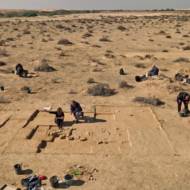
Located on the southeastern edge of Rosh HaAyin are the remains of the Migdal Tsedek fortress. The video provides an aerial view of the fortress, revealing a part of Israel's ancient history.
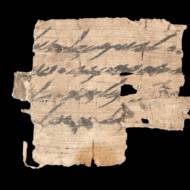
The document, dated to the late seventh or early sixth century BCE, is written in ancient Hebrew script on papyrus, and probably originated in the Judean Desert caves.
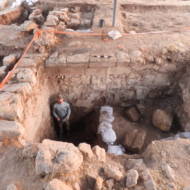
The site is identified with the biblical figure Joshua’s city of Timnat Serach and is considered by ancient sources to be the town in which he lived and was buried.
Although the matter is still hotly debated, there is evidence indicating that the Exodus story may have taken place earlier than assumed by many archaeologists.
 Français
 Español
 English
 Portuguese