 Français
 Español
 English
 Portuguese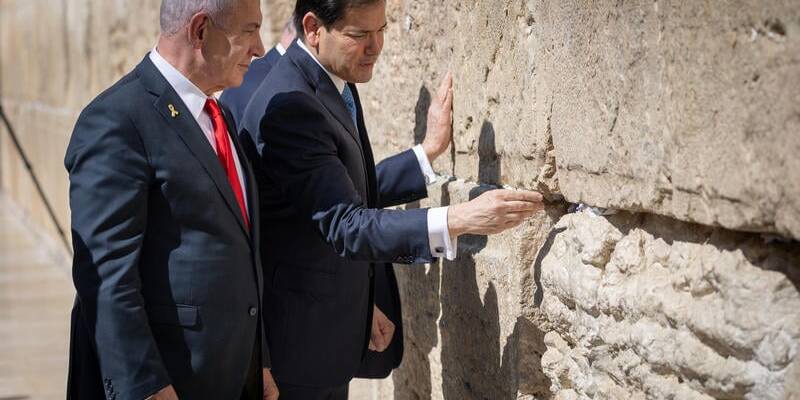
Rubio affirmed Israel’s right to decide its course but warned that immediate sovereignty moves could jeopardize Washington’s Gaza peace plan.
By United with Israel Staff
The Trump administration on Wednesday urged Israel to delay applying sovereignty over parts of Judea and Samaria, warning that such a move at this stage could complicate ongoing international efforts to stabilize Gaza and preserve the fragile ceasefire.
Speaking to reporters ahead of his scheduled visit to Israel, US Secretary of State Marco Rubio reaffirmed America’s strong support for Israel’s security and right to defend itself.
At the same time, he emphasized that the administration’s immediate priority is to ensure that Hamas is held accountable for its repeated ceasefire violations and its brutality toward civilians in Gaza.
Rubio described Hamas’ conduct as “horrifying,” noting that the terror group continues to attack rival clans and oppress its own people. He expressed optimism that the International Stabilization Force, now being assembled under US coordination, could soon help enforce the truce and bring greater stability to the region.
“Countries outside the Middle East are prepared to contribute to the international stabilization force,” Rubio said. He added that this reflects a growing global alignment against Hamas and broad support for lasting peace built on Israel’s leadership and regional cooperation.
Rubio also commented on the two preliminary sovereignty bills that passed their first votes in the Knesset earlier in the day.
Both measures were introduced by opposition parties and call for extending Israeli law to parts of Judea and Samaria, a step widely supported by many Israelis who see it as an affirmation of their historic and legal rights to the land. They highlight growing public and political momentum toward asserting Israel’s rightful presence in these territories.
One of the bills, submitted by Avi Maoz of the Noam faction, calls for applying full Israeli sovereignty to all Jewish communities in Judea and Samaria. It passed by a narrow margin of 25 to 24 after Prime Minister Benjamin Netanyahu instructed coalition members to oppose it for now, citing the need to maintain diplomatic stability.
The other, advanced by the Israel Beytenu party, proposes sovereignty only over Ma’ale Adumim, a major city east of Jerusalem. It passed a preliminary reading by a vote of 32-9.
Rubio acknowledged Israel’s right to debate and vote on the issue but cautioned that immediate action could interfere with Washington’s Gaza peace plan. “They passed a vote in the Knesset, but the president has made clear that’s not something we’d be supportive of right now,” he said. “We think there’s potential for it to threaten the peace deal.”
He added that while the United States respects Israel’s democratic process, timing remains crucial. “They’re a democracy, people are going to have their votes, people are going to take these positions, but at this time we think it might be counterproductive,” Rubio said.
For Israel, the sovereignty debate continues to reflect a deeper national struggle between short-term diplomatic concerns and the long-term vision of affirming Jewish sovereignty in Judea and Samaria. Many see this step as essential to Israel’s identity, security, and future.
As Washington works to consolidate a post-war framework in Gaza, Israeli leaders are balancing diplomacy with determination, confident that full recognition of Israel’s sovereignty in its heartland is a matter of not if, but when.
Do You Love Israel? Make a Donation - Show Your Support!

Donate to vital charities that help protect Israeli citizens and inspire millions around the world to support Israel too!
Now more than ever, Israel needs your help to fight and win the war -- including on the battlefield of public opinion.
Antisemitism, anti-Israel bias and boycotts are out of control. Israel's enemies are inciting terror and violence against innocent Israelis and Jews around the world. Help us fight back!

