 Français
 Español
 English
 Portuguese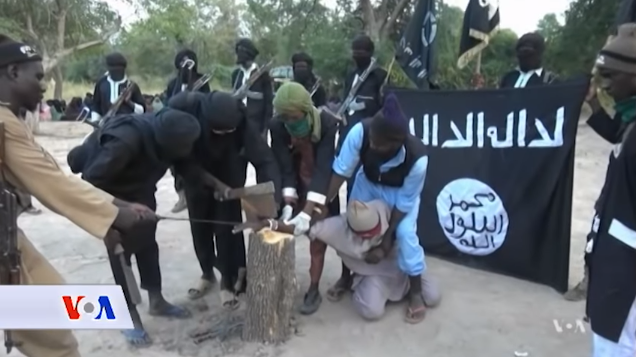
Last month, multiple terrorist attacks in Nigeria’s Maiduguri killed 25 people and injured more than 200.
By David Michael Swindle, The Algemeiner
US lawmakers this week raised alarm bells over the rising terrorist threat from Africa, advocating for continued American support for African nations fighting Islamists as the continent becomes the center of global terrorism.
The US Senate Subcommittee on Africa and Global Health Policy, which is part of the larger Foreign Relations Committee, held a hearing in which legislators highlighted the importance of combating terrorist groups in Africa while jousting over President Donald Trump’s approach to the continent.
“Today, the center of gravity for global terrorism has shifted to Africa. It has shifted partly and in fact precisely because of the export of violent Islamic terrorism from the Middle East as well as because of incredibly complicated and specific local dynamics,” said Sen. Ted Cruz (R-TX), who chairs the subcommittee.
“Across the Sahel in West Africa and in East Africa, terrorist groups are expanding, embedding, and operating with increasing capability,” Cruz added. “ISIS affiliates and al-Qaeda-linked groups are growing, controlling territory, and exploiting weak governance.”
The Sahel region runs 3,360 miles across the African continent, dividing the Sahara Desert to the north from the tropical southern savannahs. Terrorist hot spots in recent years in the region have included Mali, Burkina Faso, and Niger, where, Cruz noted, “JNIM [Jama’at Nusrat al-Islam wal-Muslimin], and Islamic State in the Sahel have all expanded. In Nigeria, Boko Haram, ISIS West Africa, and Fulani extremists are mass slaughtering Christians.”
In November, the Combating Terrorism Center at West Point released a study documenting that in 2024, 86 percent of all terrorism-related deaths occurred in just 10 countries, with seven of them in Africa and five in the Sahel. The researchers identified JNIM as being behind 83 percent of the killings.
Describing the threats in the Horn of Africa region, Cruz said that, in Somalia, al-Shabaab “targets Americans and threatens US personnel and partners in East Africa, all while receiving support from the Iran-backed Houthis in Yemen.”
“In region after region, terrorist groups are outpacing the ability of local governments to respond,” he added. “The failures threaten our interest globally and endanger the American homeland. The threat is rapidly growing and demands attention.”
The Texas senator also took time in his opening remarks to criticize former US President Joe Biden’s approach to Africa.
“For too long, however, Africa was treated as a theater where we didn’t have interests. Presidential administrations either ignored it or used it as a playground for self-indulgent ideological experiments,” Cruz said. “The latter problem was particularly acute during the previous administration. That mismatch allowed terrorist groups to expand and global adversaries, in particular Russia, China, and Iran, to intervene and undermine American interests. Those dynamics now threaten US interests, our allies, and ultimately the American homeland.”
After concluding, Cruz allowed Sen. Cory Booker (NJ), the top Democrat on the subcommittee, to offer his own assessment.
“What we are discussing today is not far away. It’s not disconnected from American life. It’s not some side issue we can afford to regulate to the margins of our senatorial and administrative focus,” Booker said. “Africa is not peripheral to the national security of the United States and to the urgencies we face.”
Booker added that, earlier this year, “the US intelligence community assessed that Africa has become ‘a focal point for the global Sunni Jihadist movement.’ That is not a passing warning. That is a flashing red light.”
Echoing Cruz’s concerns, Booker noted that “al-Shabaab remains a deadly and determined force who has killed civilians, killed Americans, threatened US interests, and plotted a 9/11 style attack against the United States.” He also described how “ISIS Somalia is emerging as a more significant node in the broader ISIS network with demonstrated intent and capability to threaten beyond the region, including against the United States.”
The senator went on to discuss the Sahel, pointing to how “in the Lake Chad Basin, IS West Africa and Boko Haram continue to exploit borders that are weak, states that are strained, and communities that have been failed by their governments for far too long. So, let’s be clear, counterterrorism in Africa is not charity. It is not a distraction. It’s not optional for our country. It is a core American national security interest.”
Booker named the factors that fueled terrorist groups in the region, saying, “They feed on corruption. They feed on broken governance. They feed on despair. They feed on the absence of state legitimacy, the weakness of institutions, the pain of exclusion, and the vulnerability of young people who see too few pathways to dignity, work, and hope.”
Emphasizing that “military strikes alone cannot prevent extremist groups from returning the moment attention shifts and the dust settles,” the New Jersey Democrat argued that combating the threat takes “strategy, patience, partnerships, diplomacy, development, and security working together.”
Booker then criticized the Trump administration for its approach to Africa, describing it as “retreat dressed up as resolve,” in part due to “diminished diplomatic presence” across the continent.
“The Trump administration is not delivering a whole-of-government strategy. It is delivering a whack-a-mole policy dressed up as counterterrorism,” Booker argued. “It is fragmented. It is reactive. It is too often militarized and under-strategized. Because the future of American security is bound up with the future of the stability, prosperity, and partnerships we have on the African continent, we need a strategy that reflects the true conditions on the ground and not only frames Africa as a problem but actually sees the real framing that it is an extraordinary asset.”
Cruz defended the Trump administration’s efforts in Africa.
“As I’ve said, one of the reasons for these hearings is to ensure that the administration officials have the opportunity and the platform to articulate President Trump’s approach to Africa. For too long, US policy has treated Africa as a secondary theater,” Cruz said. “The Biden administration withdrew US forces from Niger, which was a key foothold in the region that is the epicenter of global terrorism. That assumption is no longer tenable for a range of reasons.”
Cruz said that Trump “personally met with 13 African heads of state in his first year in office. But too often there is nonetheless a lazy assumption that the US is disengaging from Africa.”
Nick Checker, senior official in the State Department’s Bureau of Africa Affairs, testified before the committee.
“Africa will play an important role in America’s economic future. The continent holds vast critical minerals, energy resources, and tremendous human capital,” he said. “However, these opportunities cannot be fully realized amid persistent instability in parts of the continent, including terrorist threats, which continue to affect US interests.”
Checker described the limited nature of the administration’s approach.
“Our counterterrorism posture in Africa is narrowly focused and aligned with US national security priorities. The primary objective is clear: We will protect the homeland from threats while safeguarding US citizens and commercial interests abroad,” Checker said. “Groups affiliated with ISIS and al-Qaeda remain active in the Sahel, Nigeria, and parts of East Africa. These threats are real, but our response must be disciplined.”
On April 16, troops in Nigeria killed 25 fighters in the Islamic State West Africa Province (ISWAP) terror group during a failed attack in the Borno state.
“We will not pursue large-scale, indefinite military engagements, or nation building efforts,” Checker said. “Instead, we are adopting a targeted approach that emphasizes intelligence sharing and limited, high impact security cooperation with partners who demonstrate both capability and political will.”
Regarding the Sahel, Checker said “a region that accounted for 5-10 percent of terrorism-related deaths a decade ago, now represents more than 50 percent. Despite significant American engagement, the strategic picture demonstrates that open-ended, aid-centric approaches have not delivered sustainable security outcomes. This is why a fundamental rethink is necessary.”
In his conclusion, Checker noted that “our approach is grounded in respect for sovereignty and realism about political conditions on the ground. We engage governments as they are, not as we wish them to be.”
Monica Jacobson, senior official for the Bureau of Counterterrorism, also testified and explained how the administration’s approach was guided by three core principles: neutralizing terrorist threats before they reached the US, supporting regional partners instead of replacing them, and defending critical supply chains.
“Moroccan forces previously trained by the Bureau of Counterterrorism now train Sahelian forces across sub-Saharan Africa, using US-provided curricula,” Jacobson said. “This is precisely the model we seek to expand, with regional partners leading and sustaining regional security efforts.”
Jacobson continued, “We also recognize that, in many parts of Africa, radical Islamic terrorists target civilians based on their Christian faith. As President Trump and Secretary Rubio have made clear, we will respond to atrocities and violence against Christians, including those who knowingly direct, authorize, fund, support, or carry out violations of religious liberty. Our counterterrorism efforts have included directly targeting the terrorists responsible for this violence, and we likewise hold governments’ feet to the fire when they fail to address terrorist threats that undermine religious freedom.”
Former Nigerian Information Minister Lai Mohammed responded to the hearing on Wednesday when speaking at Abbey College in Cambridge.
“Now, people say that there is religious persecution in Nigeria and that there is genocide against Christians,” Mohammed said. “It’s not true. It is fake news.” He defended Nigeria as fostering a culture that promotes interfaith tolerance.
Chigozie Ubani, a fellow at the Institute of Security Nigeria, has discussed Boko Haram’s attacks.
“Their target is to terrorize, maim, and displace people,” Ubani told Nigeria’s Punch News. “Once they displace them, of course, they occupy the space. So, for as long as that is not achieved, they can only retreat and come back.”
Last month, multiple terrorist attacks in Nigeria’s Maiduguri killed 25 people and injured more than 200.
“Their goal is to take over our territories,” Ubani said. “When they take over, everybody there will submit to their religious authority. That’s what it is.”
Earlier this week, officials from both Mali and Niger accused their neighboring countries of supporting terrorism. At the sidelines of a security forum in Senegal, Malian Foreign Minister Abdoulaye Diop claimed that other countries were “harboring terrorist groups” and allowing them to operate against Mali. Niger officials have previously accused France of backing terrorism and faced criticism for allegedly concealing the severity of Islamist terror attacks.
On Saturday, US Africa Command released a statement announcing strikes had occurred on Friday, targeting Islamic State terrorists in the mountain regions of Puntland, the Easternmost state of Somalia. The attacks targeted territory approximately 30 miles southeast of the port city of Bosaso in the Bari region. No casualty numbers were announced.
On Wednesday, Puntland forces displayed the corpses of more than 10 suspected Islamic State fighters killed in the strikes on the Jaceel Valley area of the Calmiskaad mountain range.
Video shared from the scene showed bodies in what appeared to be a crater from an airstrike.
Do You Love Israel? Make a Donation - Show Your Support!

Donate to vital charities that help protect Israeli citizens and inspire millions around the world to support Israel too!
Now more than ever, Israel needs your help to fight and win the war -- including on the battlefield of public opinion.
Antisemitism, anti-Israel bias and boycotts are out of control. Israel's enemies are inciting terror and violence against innocent Israelis and Jews around the world. Help us fight back!

