 Français
 Español
 English
 Portuguese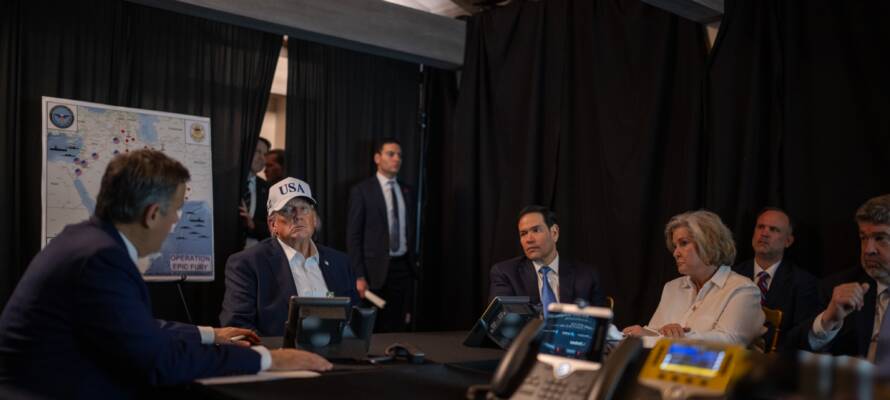
A senior Iranian official denied that Tehran agreed to transfer its enriched uranium, saying the nuclear issue is not part of the preliminary deal.
By United with Israel Staff
The United States continues to update Israel on ongoing negotiations tied to reopening the Strait of Hormuz, as a potential agreement with Iran appears to be taking shape, though key details remain unclear.
U.S. President Donald Trump said Saturday night that a deal is close following a series of calls with regional leaders.
“I am in the Oval Office… where we just had a very good call” with leaders from Saudi Arabia, the United Arab Emirates, Qatar, Pakistan, Turkey, Egypt, Jordan, and Bahrain, Trump wrote, adding that discussions focused on Iran and a broader “Memorandum of Understanding pertaining to peace.”
“An Agreement has been largely negotiated, subject to finalization between the United States of America, the Islamic Republic of Iran and the various other Countries,” Trump said, adding that final details “are currently being discussed and will be announced shortly.” He also stated that the Strait of Hormuz “will be opened” as part of the arrangement.
Trump said he also spoke with Israeli Prime Minister Benjamin Netanyahu, noting the call “went very well,” as Washington continues to coordinate closely with Jerusalem.
A senior Israeli official said Netanyahu emphasized that Israel will maintain freedom of action against threats across all arenas, including Lebanon, a position Trump reaffirmed. The president also made clear he would insist on dismantling Iran’s nuclear program and removing all enriched uranium from its territory as part of any final deal.
Still, major questions remain over what Iran has actually agreed to.
The New York Times reported earlier that Tehran had agreed in principle to give up its stockpile of highly enriched uranium, including material enriched to 60 percent, as part of the emerging framework.
That account was quickly contradicted by Reuters, which cited a senior Iranian official saying Iran has not agreed to transfer its enriched uranium and that the nuclear issue is not part of the preliminary deal.
The uncertainty has triggered sharp criticism from Republicans. Sen. Lindsey Graham warned that any agreement allowing Iran to retain the ability to threaten the Strait of Hormuz would fundamentally shift the regional balance of power.
“If a deal is struck to end the Iranian conflict because it is believed that the Strait of Hormuz cannot be protected from Iranian terrorism and Iran still possesses the capability to destroy major Gulf oil infrastructure, then Iran will be perceived as being a dominant force requiring a diplomatic solution,” Graham wrote.
He added that Iran maintaining the ability to “terrorize the Strait in perpetuity” and inflict damage on Gulf oil infrastructure “is a major shift of the balance of power in the region and over time will be a nightmare for Israel.”
Graham also questioned the premise behind the negotiations, saying he is “skeptical of the idea that Iran cannot be denied the ability to terrorize the Strait.”
With a deal said to be close but core issues still disputed, the question now is whether a breakthrough is truly within reach, or whether the gaps between the sides are simply too wide to bridge.
Do You Love Israel? Make a Donation - Show Your Support!

Donate to vital charities that help protect Israeli citizens and inspire millions around the world to support Israel too!
Now more than ever, Israel needs your help to fight and win the war -- including on the battlefield of public opinion.
Antisemitism, anti-Israel bias and boycotts are out of control. Israel's enemies are inciting terror and violence against innocent Israelis and Jews around the world. Help us fight back!

