
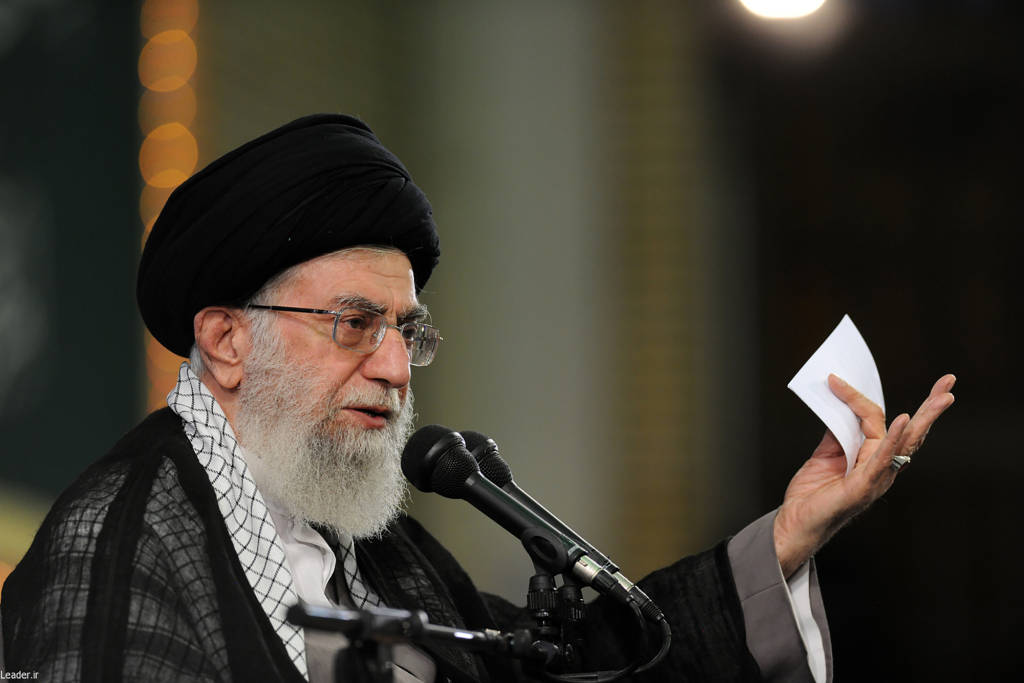
Despite the regime’s attempts to project confidence, pressure on Tehran continues to grow as a second U.S. carrier strike group approaches the region.
By Mardo Soghom, Middle East Forum
While American and Iranian representatives met in Geneva on February 17, 2026, to discuss a possible resolution of nuclear and related disputes, Supreme Leader Ali Khamenei delivered his most direct public attack yet against President Donald Trump, mocking the U.S. naval buildup in the region.
Apparently referring to the aircraft carrier USS Gerald R. Ford, which was headed for the Strait of Gibraltar, Khamenei said, “Of course, a warship is a dangerous piece of military hardware. However, more dangerous than that warship is the weapon that can send it to the bottom of the sea.”
His official website reinforced the message by publishing an AI-generated image showing the carrier sunk beneath the water.
The hardline Khorasan daily, close to parliament speaker Mohammad Bagher Ghalibaf, highlighted the confrontation.
“Contrary to public—and even global—expectations about the need to back down and avoid confronting Trump, the leadership instead drew the sword and engaged him in the media arena,” the newspaper wrote.
Khamenei’s need to project strength was evident. The same day he escalated his rhetoric, thousands took to the streets during fortieth-day mourning ceremonies for civilians killed in the January unrest.
The Islamic Revolutionary Guard Corps deployed regular and paramilitary units in Mashhad, parts of Tehran, and numerous smaller towns to contain demonstrations. Even students protested inside classrooms, despite the presence of Basij members in schools.
State-controlled media prominently covered Khamenei’s speech while also emphasizing Foreign Minister Abbas Araghchi’s cautiously optimistic but vague statement after the Geneva meeting that negotiators had made “progress.”
Tehran’s approach appears aimed at prolonging negotiations to counter the Trump administration’s push for clear concessions.
Nour News, affiliated with the Supreme National Security Council, accused Washington of avoiding substantive talks, arguing that Iran arrived with technical experts prepared to address complex issues and was ready to remain longer for detailed discussions.
“U.S. conduct shows multiple signs of a lack of seriousness in the time and effort devoted to the talks,” the outlet said, criticizing the dispatch of figures such as Trump’s envoy Steve Witkoff and son-in-law Jared Kushner without coordinated technical and legal teams.
It also faulted Washington for combining negotiations with media messaging and military signaling, which it described as shifting diplomacy away from “real dialogue” toward “psychological warfare and political theater.”
The article portrayed Trump as influencing the atmosphere of negotiations from outside the formal process.
By stressing the importance of talks while issuing contradictory messages and suggesting indirect involvement, the newspaper said, Trump was trying to unsettle the “psychological balance” of the process.
Tehran, it said, treated this as an internal U.S. matter and avoided reacting to what it considers media-driven gestures.
Years of U.S.-Iran diplomacy suggest Khamenei supervises negotiations. Iranian delegations pause consultations to seek guidance from his office, while he publicly frames red lines and simultaneously presents himself as detached from the talks.
Tasnim News, affiliated with the Islamic Revolutionary Guard Corps, highlighted another part of Khamenei’s speech, in which he said Trump will never succeed in weakening or destroying the Islamic Republic.
Tasnim argued that President Barack Obama reached the conclusion that he should engage with Tehran.
“Now, the America of Trump has likely reached the same conclusion as the America of Obama…,” it said, adding, “Despite heavy pressure from the criminal Zionist government and opposition proxies to persuade him to attack Iran again, Trump has chosen the option of negotiations.”
Despite the regime’s attempts to project confidence, pressure on Tehran continues to grow as a second U.S. carrier strike group approaches the region.
There is still no indication that Tehran is prepared to make major concessions. Instead, it appears to be counting on a prolonged diplomatic process to avert military action while reportedly continuing efforts to harden nuclear facilities.
Do You Love Israel? Make a Donation - Show Your Support!


Donate to vital charities that help protect Israeli citizens and inspire millions around the world to support Israel too!
Now more than ever, Israel needs your help to fight and win the war -- including on the battlefield of public opinion.
Antisemitism, anti-Israel bias and boycotts are out of control. Israel's enemies are inciting terror and violence against innocent Israelis and Jews around the world. Help us fight back!