
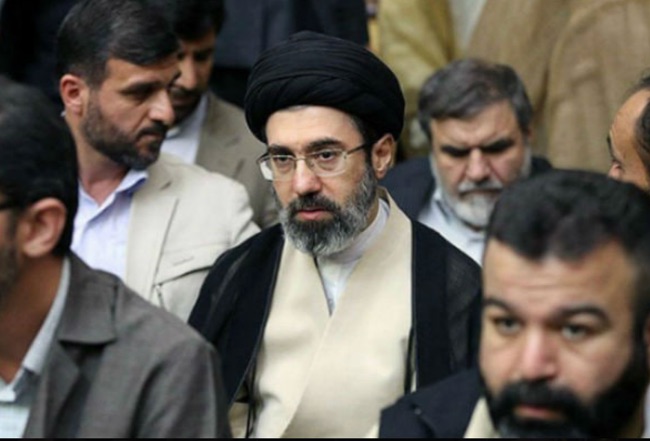
The recent sequence of carefully publicized meetings increasingly appears to be designed to communicate a single message: Mojtaba Khamenei is alive.
By Mardo Soghom, Middle East Forum
In a continuing effort to reinforce the image of the new supreme leader, Mojtaba Khamenei, as an active and functioning leader, Iranian state-linked media once again have highlighted a reported high-level meeting between him and the country’s military leadership.
Just days after President Masoud Pezeshkian said he met with Mojtaba and spoke with him for hours—a statement widely interpreted as an attempt to counter persistent speculation about Khamenei’s condition and lack of visibility—Tasnim News Agency published another account with the same theme.
According to the report, published on May 10, 2026, Major General Ali Abdollahi, commander of Iran’s Khatam al-Anbiya Central Headquarters, briefed Mojtaba on the readiness of the armed forces, including the army, the Islamic Revolutionary Guard Corps, police, intelligence services, border forces, the defense ministry, and the Basij militia.
The military content of the report is familiar. Abdollahi claimed Iran’s forces possess high defensive and offensive readiness and warned that Iran would meet any “strategic mistake” by the United States or Israel with a rapid and powerful response.
More notable, however, is the political messaging the report embodies. Tasnim repeatedly emphasizes that Mojtaba has received military briefings, issued new directives, and continues to oversee strategic decisions following what Iranian media call the “Third Imposed War.”
The apparent objective is less about showcasing military readiness—a routine feature of Iranian state media rhetoric—and more about projecting continuity, control, and leadership at the top of the system.
Since the death of Supreme Leader Ali Khamenei and the outbreak of war, Mojtaba Khamenei has been absent from public view, fueling speculation inside and outside Iran about his role, his health, and his grip over the state apparatus.
No one outside of a close circle knows whether he is injured or even dead.
Against that backdrop, the recent sequence of carefully publicized meetings increasingly appears to be designed to communicate a single message: Mojtaba Khamenei is alive, engaged, and firmly in command of the Islamic Republic.
State media also claim that Mojtaba happened to be in the courtyard of his father’s compound on the morning of February 28, when several precision bombs or missiles hit the buildings, and he thus survived the attack with relatively manageable injuries. Most of Khamenei’s family, including Mojtaba’s wife, were killed.
The effort to portray the new supreme leader as being in control follows growing reports of internal rivalries among the Islamic Republic’s remaining power centers. For the past two decades, Ali Khamenei stood as the unquestioned authority at the top of the system and largely managed internal disputes behind closed doors. In his absence, however, competition over influence, resources, and decision-making authority appears increasingly likely to intensify. Iran’s political and economic system is built around networks of patronage.
Many of the Revolutionary Guard’s top brass and key politicians control vast economic networks in addition to carrying out their military roles. Friends, relatives, and political allies of senior commanders often secure lucrative management positions in quasi-private petrochemical, telecommunications, industrial, or financial companies tied to the state’s wider patronage structure. In such a nepotistic system, proximity to the supreme leader—or the ability to credibly claim access to him and speak on his behalf—can determine careers, fortunes, and political survival.
As long as Mojtaba remains unable or unwilling to appear publicly and visibly demonstrate his well-being, those able to speak or act on his behalf are likely to retain the upper hand inside the system. That reality may deepen uncertainty over who is shaping strategic decisions in Tehran.
Do You Love Israel? Make a Donation - Show Your Support!


Donate to vital charities that help protect Israeli citizens and inspire millions around the world to support Israel too!
Now more than ever, Israel needs your help to fight and win the war -- including on the battlefield of public opinion.
Antisemitism, anti-Israel bias and boycotts are out of control. Israel's enemies are inciting terror and violence against innocent Israelis and Jews around the world. Help us fight back!