
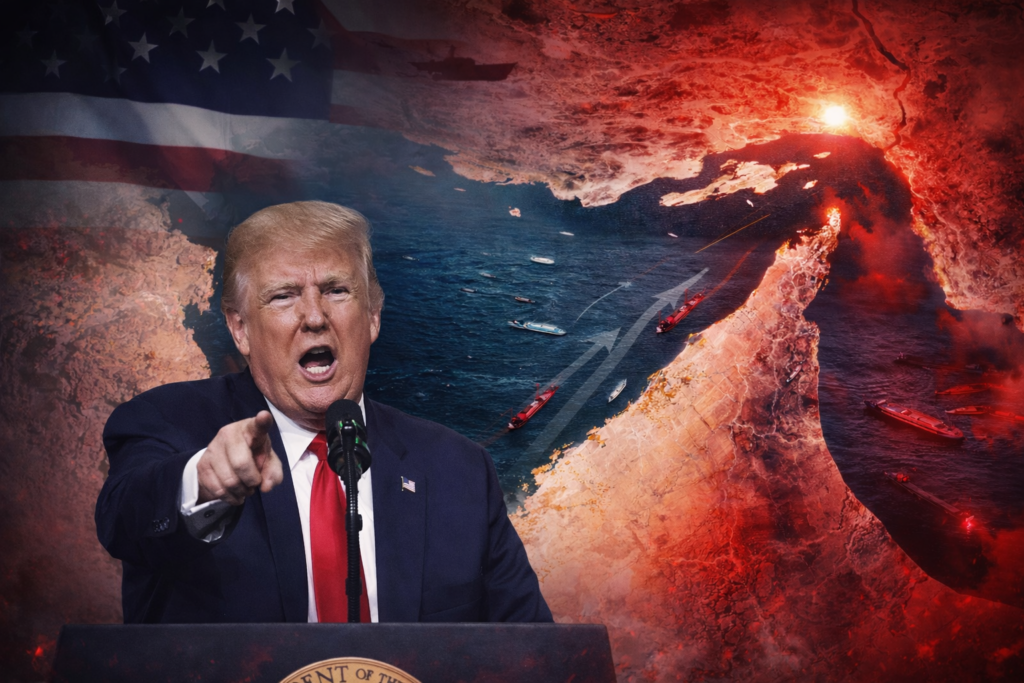
President emphasized that the United States and Israel remain closely aligned in their broader objectives against Iran.
By United with Israel Staff
President Donald Trump said the United States is working to establish an international security force to police the Strait of Hormuz, with Israel also assisting efforts to keep the critical shipping corridor open as Iran continues attacking maritime traffic in the region.
Speaking to reporters aboard Air Force One, Trump said Washington has been urging other countries to join the effort to safeguard the waterway, through which a large share of the world’s oil supply passes.
“We are talking to other countries about policing the strait,” Trump said. “It’d be nice to have other countries police it with us. And we’ll help. We’ll work with them.”
Trump said the United States has already received some positive responses from governments contacted about the effort but indicated Washington is prepared to move ahead regardless of how many allies ultimately participate.
“And I think we’re getting a good response,” he said. “If we do, that’s great. And if we don’t, that’s great too.”
The president said several countries had already been approached about contributing naval assets, including minesweepers and patrol vessels, warning that even a small number of hostile actors could disrupt traffic through the narrow passage.
“It only takes a couple of people to screw up the strait,” Trump said, noting that mines or small attacks on shipping could quickly halt traffic through the critical corridor.
Asked about Israel’s role in securing the waterway, Trump confirmed that Jerusalem is working closely with Washington.
“They’re working with us,” Trump said, dismissing reports of tensions with Israeli Prime Minister Benjamin Netanyahu. “My relationship with Bibi Netanyahu is, I would say, extraordinary, actually.”
Trump also emphasized that the United States and Israel remain closely aligned in their broader objectives against Iran.
“I think we have similar objectives really,” he said, noting that Israel faces the threat directly while the United States operates from a greater distance. “They’re there and we’re very far away, but I think we probably have pretty similar [goals].”
Earlier, in an interview with the Financial Times, Trump argued that countries that benefit most from the shipping route should help protect it.
“It’s only appropriate that people who are the beneficiaries of the strait will help to make sure that nothing bad happens there,” Trump said. He warned that if allies decline to participate, “it will be very bad for the future of NATO.”
Trump also pointed to U.S. support for NATO allies and Ukraine as an example of Washington’s longstanding role in defending its partners.
“Remember, in many cases they’re NATO countries. We’re always there for NATO,” he said aboard Air Force One, adding that the United States had been “helping them with Ukraine” even though, in his words, “between us, it doesn’t affect us.”
Some governments have already signaled reluctance. Officials in Australia and Japan indicated they would not send naval forces to the region at this stage.
Meanwhile, French President Emmanuel Macron said he recently spoke with Iranian President Masoud Pezeshkian and urged Tehran to halt attacks on regional shipping and end its blockade of the strait.
The Strait of Hormuz, which connects the Persian Gulf with the Gulf of Oman, remains one of the world’s most important energy chokepoints. Roughly a quarter of the world’s oil shipments normally pass through the narrow waterway, making it a vital artery for global energy markets.
Since the outbreak of the war, Iran has launched multiple attacks on commercial vessels attempting to transit the strait, raising fears that the conflict could disrupt global oil supplies.
Trump also said U.S. military operations against Iran have significantly weakened Tehran’s ability to threaten the region, claiming that Iranian missile and drone capabilities have been sharply reduced.
“They’re shooting very few of them,” Trump said of Iran’s missiles. “You know why? Because they don’t have very many of them.”
Still, the president declined to formally declare victory, saying that while Iran’s military has been severely damaged, the conflict is not yet finished.
“If we left right now, it would take them 10 years at war to rebuild,” Trump said. “But I’m still not declaring it over.”
Do You Love Israel? Make a Donation - Show Your Support!


Donate to vital charities that help protect Israeli citizens and inspire millions around the world to support Israel too!
Now more than ever, Israel needs your help to fight and win the war -- including on the battlefield of public opinion.
Antisemitism, anti-Israel bias and boycotts are out of control. Israel's enemies are inciting terror and violence against innocent Israelis and Jews around the world. Help us fight back!