
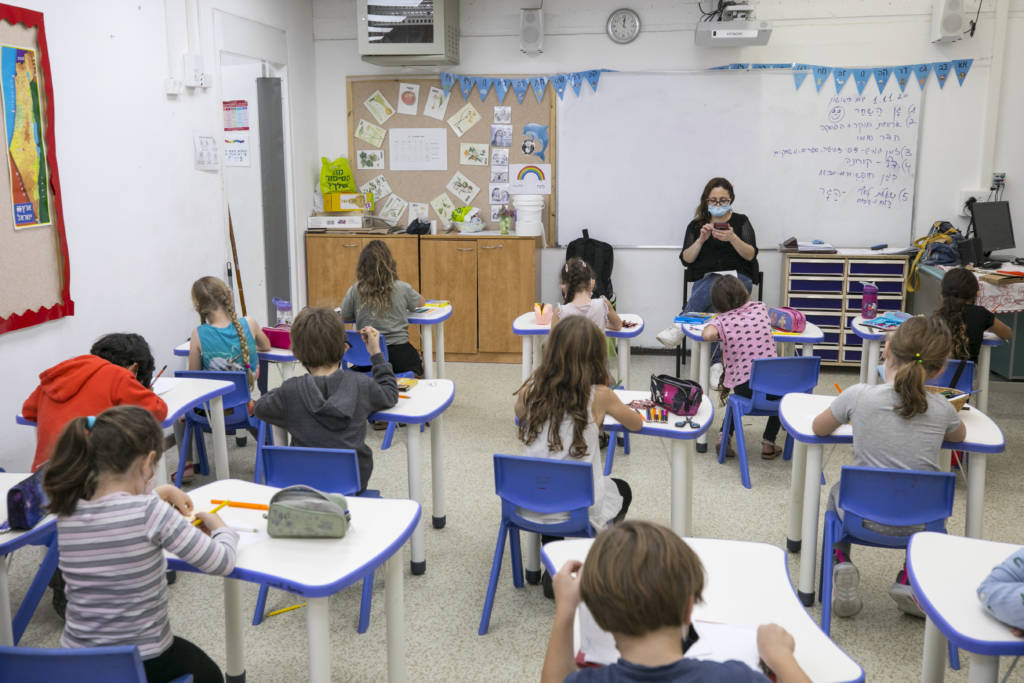
According to the authors, the findings highlight the importance of policies that expand access to early childhood education.
By Shula Rosen
A new study from the Shoresh Institution for Socioeconomic Research has found that the age at which children begin preschool plays a significant role in shaping their future academic performance.
The research, conducted by Prof. Ayal Kimhi, Prof. Dan Ben-David, and Ariela Savin, analyzed international PISA exam data and concluded that students who start preschool before age five consistently achieve stronger results, particularly in Israel.
The study compared Israeli students with peers in five top-performing nations—Canada, Estonia, Finland, Japan, and Taiwan—and revealed that while early preschool enrollment is beneficial everywhere, its impact is far greater in Israel.
For example, after controlling for various background factors, the gap in achievement between students who began preschool before age five and those who started later was 6.4 percent in Israel’s state-religious schools, compared to 2.7 percent in the state system and just 1.6 percent in the leading nations.
Researchers suggest that Israel’s wider socioeconomic and cultural-linguistic divides amplify the effect of early education.
Preschool, they argue, helps close these gaps by giving children exposure to language and cultural tools earlier, better preparing them to succeed in school.
The study also investigated whether parents’ education levels influenced outcomes.
In the leading countries, children of academically educated mothers benefited most from early preschool entry.
In Israel, however, the researchers found no significant connection between mothers’ education levels and achievement gaps.
This indicates that Israeli children from all backgrounds gain from early preschool participation.
Data were drawn from the PISA exams of 2015, 2018, and 2022, spanning Israel’s state, state-religious, and Arab school systems.
The study defined early preschool entry as starting before age five, which was Israel’s compulsory age until reforms in 2012 extended mandatory education to age three.
According to the authors, the findings highlight the importance of policies that expand access to early childhood education.
By doing so, Israel could strengthen social mobility, reduce inequality, and bolster long-term economic growth.
Do You Love Israel? Make a Donation - Show Your Support!


Donate to vital charities that help protect Israeli citizens and inspire millions around the world to support Israel too!
Now more than ever, Israel needs your help to fight and win the war -- including on the battlefield of public opinion.
Antisemitism, anti-Israel bias and boycotts are out of control. Israel's enemies are inciting terror and violence against innocent Israelis and Jews around the world. Help us fight back!