
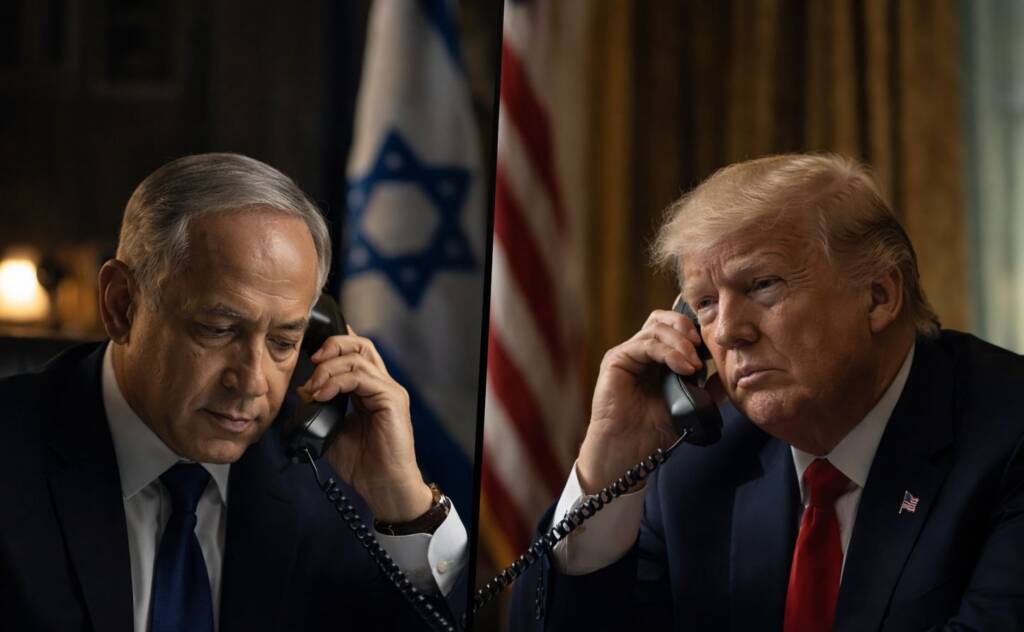
During the call, Netanyahu relayed highly sensitive intelligence to Trump about a rare operational opportunity.
By United with Israel Staff
A confidential phone call between President Donald Trump and Israeli Prime Minister Benjamin Netanyahu on February 23 helped set in motion the strike that ultimately killed Iran’s Supreme Leader Ayatollah Ali Khamenei, according to a report by Axios, citing sources familiar with the discussion.
During the call, Netanyahu relayed highly sensitive intelligence to Trump about a rare operational opportunity involving Iran’s leadership.
According to three sources briefed on the conversation, Netanyahu told Trump that Israeli military intelligence had identified a rare opportunity: Iran’s Supreme Leader Ayatollah Ali Khamenei and several of his top advisers were expected to gather at a single location in Tehran on Saturday morning.
Netanyahu told the president that the gathering could present a chance to eliminate a significant portion of Iran’s leadership in a single devastating airstrike.
The information triggered immediate coordination between Washington and Jerusalem. At Trump’s direction, the CIA conducted an urgent intelligence review to verify the Israeli assessment.
Officials familiar with the process said the agency confirmed key elements of the intelligence about Khamenei’s movements and the planned meeting, increasing confidence that the opportunity was real.
The intelligence confirmation built on months of monitoring by U.S. intelligence agencies.
According to reporting by The New York Times, the CIA had been tracking Khamenei’s movements and security patterns for an extended period, gradually building a detailed picture of his locations, travel routines, and protective arrangements.
That long-term intelligence effort allowed American officials to quickly validate the information provided by Israeli military intelligence once the potential strike window emerged.
The phone call also focused heavily on managing the risks of escalation.
According to officials familiar with the discussion, Trump assured Netanyahu that the United States would provide a military and diplomatic “safety net” designed to deter Iranian retaliation and prevent the conflict from spiraling out of control.
American military deployments in the region and increased intelligence cooperation were intended to reinforce that deterrence while giving Israel the operational freedom to move forward with the strike.
Initial planning envisioned launching the attack overnight under cover of darkness.
However, once confirmation of the Tehran gathering was received, leaders in Washington and Jerusalem decided to adjust the timing and carry out the operation during daylight hours in order to exploit what officials viewed as a unique operational opportunity.
Early Saturday morning, Israeli aircraft struck the Tehran compound where Khamenei was meeting with senior advisers and defense officials.
According to officials familiar with the operation, Israeli warplanes dropped approximately 30 bombs on the building during the meeting, destroying the structure and killing multiple members of Iran’s senior leadership.
The strike was part of a broader wave of Israeli and American attacks launched at the start of the campaign against Iran’s military leadership and strategic infrastructure.
U.S. and Israeli officials said dozens of senior Iranian figures were killed during the first day of strikes alone. Sources told CBS News that roughly 40 top officials from Iran’s political, military, and nuclear establishments were eliminated during the opening phase of the operation.
Among those killed was Ali Shamkhani, a key member of Khamenei’s inner circle and one of the Islamic Republic’s most influential decision-makers.
Shamkhani served on the Expediency Discernment Council and previously held several of Iran’s most powerful security posts, including secretary of the Supreme National Security Council and defense minister.
Iranian state media later confirmed that Khamenei had been killed in the strike, reporting that his remains were recovered from the rubble of the destroyed compound in Tehran.
Israeli and American officials described the operation as an unprecedented blow to the Iranian regime’s leadership structure, made possible by the combination of Israeli military intelligence, long-term U.S. surveillance of Iran’s leadership, and rapid coordination between Washington and Jerusalem after the opportunity was identified.
In the end, the Feb. 23 phone call between Trump and Netanyahu helped set the chain of events that culminated days later in the early Saturday morning strike that eliminated Iran’s supreme leader and a significant portion of the regime’s senior command structure.
Do You Love Israel? Make a Donation - Show Your Support!


Donate to vital charities that help protect Israeli citizens and inspire millions around the world to support Israel too!
Now more than ever, Israel needs your help to fight and win the war -- including on the battlefield of public opinion.
Antisemitism, anti-Israel bias and boycotts are out of control. Israel's enemies are inciting terror and violence against innocent Israelis and Jews around the world. Help us fight back!